
Connect with us today to learn more about our industrial automation solutions—and how to commission them for your application.
China Top 10 Smart AI Glasses Manufacturers?
Choosing a Smart Ai Glasses manufacturer in China takes more than comparing product photos or headline specifications. The market includes established electronics brands, specialist wearable developers, and contract manufacturers with different strengths. Some focus on lightweight frames and prescription compatibility; others prioritize cameras, voice interaction, displays, or custom software. These distinctions matter when a concept must become a reliable product.
This guide introduces ten manufacturers and provides a practical starting point for evaluating them. It considers visible factors such as product range, optical design, battery placement, microphone performance, frame comfort, and companion-app support. It also highlights manufacturing questions buyers should verify directly, including sample availability, quality-control procedures, customization options, production capacity, and after-sales support. A polished demo is useful, but it cannot show how glasses feel after several hours or perform in a noisy street.
Details change quickly.
The list should not be treated as a certified ranking or a substitute for supplier due diligence. Manufacturer capabilities, product availability, and technical claims can change between inquiries. Before making a decision, request current specifications, inspect working samples, clarify ownership of software and designs, and confirm which services the supplier actually provides. Independent testing may reveal trade-offs that a catalogue leaves out, especially around comfort, heat, battery life, and connectivity. Even a promising supplier may not fit every project. That is worth admitting. The right partner depends on the intended users, target market, budget, and required level of customization. Use the comparisons that follow to build a shortlist, ask sharper questions, and separate a convincing prototype from a product ready for everyday use.
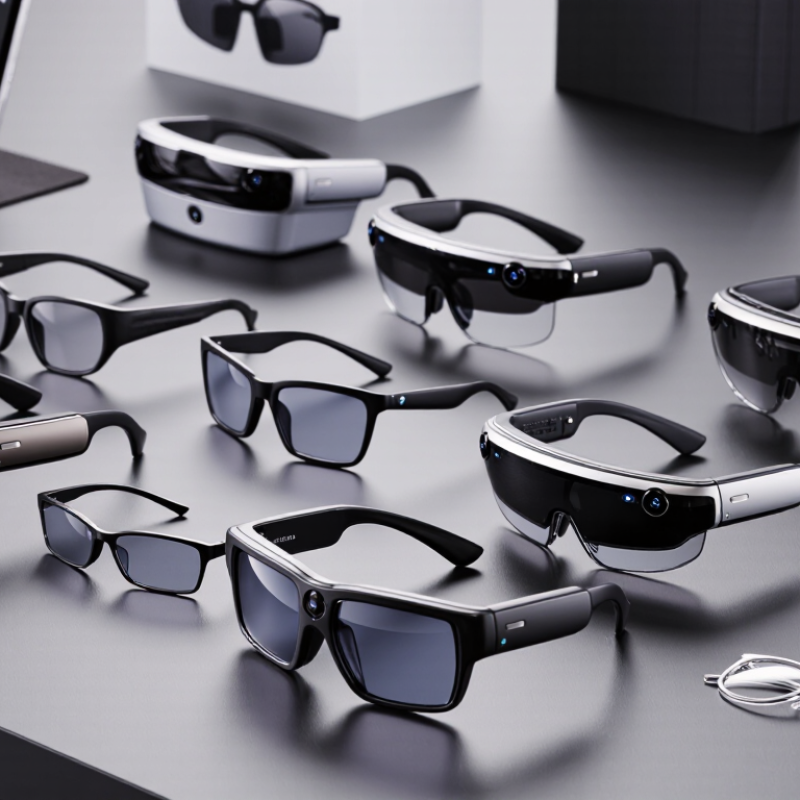
Table of Contents [Hide]
What Are Smart AI Glasses and How Are They Made in China?
Smart AI glasses are eyewear with miniature cameras, microphones, speakers, sensors, and wireless connections. Some models process voice or image tasks on the device; others send data to a paired phone or cloud service. The frame must hold these parts without becoming uncomfortable. Small details matter. A heavy temple can press behind the ear, while a poorly placed microphone may capture wind instead of speech.
In China, production typically begins with design and component selection. Engineers test frame dimensions, battery capacity, heat, and antenna placement before finalizing the layout. Factories then mold or machine frame parts, install circuit boards and wiring, fit lenses, and assemble the temples. Workers may inspect each unit under bright lighting and test charging, audio, camera focus, and wireless stability. The process is precise, but not every defect is obvious at first glance.
Reliable manufacturing also depends on traceable components and repeatable checks between production batches. Temperature tests can reveal whether the frame becomes uncomfortable during extended use. Drop and hinge tests help expose weak joints. Still, quality varies by factory, materials, and inspection depth; “made in China” alone does not explain performance. One limitation remains: compact batteries and tiny speakers often require trade-offs between runtime, comfort, and sound. That balance is not always solved neatly.
China Top 10 Smart AI Glasses Manufacturers? - What Are Smart AI Glasses and How Are They Made in China?
A manufacturing overview of ten common smart-glasses components and production considerations. This table describes product technologies and factory processes, not a ranking of companies or brands.
| No. | Component or production area | Common materials or technologies | Typical manufacturing and assembly | Key quality checks |
|---|---|---|---|---|
| 1 | Frame and hinges | Injection-molded engineering plastics, such as polyamide or polycarbonate; metal hinge parts | Frame parts are molded or machined, finished, and assembled with hinges and fasteners. | Dimensional fit, hinge movement, surface finish, and frame strength |
| 2 | Lenses and optical elements | Prescription or non-prescription lens materials; optional waveguide or other display optics in display-equipped models | Lenses are cut, edged, coated when required, and fitted into the frame; optical display parts need precise alignment. | Lens fit, optical clarity, coating appearance, and display alignment where applicable |
| 3 | Camera module | Image sensor, compact lens assembly, and camera support circuitry | Camera modules are assembled and positioned in the frame, then connected to the main board. | Focus, image capture, field of view, and camera-to-software operation |
| 4 | Microphones and audio system | MEMS microphones, miniature speakers, acoustic ports, and audio circuitry | Microphones and speakers are installed in designated frame cavities and connected to the audio electronics. | Microphone input, speaker output, channel balance, and acoustic-port blockage |
| 5 | Processor and memory | Low-power application processor, memory, and supporting electronic components | Components are mounted on a printed circuit board using surface-mount assembly and then integrated into the frame. | Board inspection, boot testing, connectivity, and thermal behavior |
| 6 | Wireless connectivity | Bluetooth and, on some designs, Wi-Fi; antennas integrated into or positioned within the frame | Radio components and antennas are assembled with the electronics, with placement tuned to the product design. | Pairing, connection stability, antenna performance, and regulatory testing requirements |
| 7 | Battery and power management | Rechargeable lithium-based cells, charging circuitry, and power-management components | Cells are secured in available frame space and connected to the power-management system. | Charging behavior, protection-circuit operation, capacity, and temperature during testing |
| 8 | Controls and sensors | Touch controls or buttons; optional inertial, proximity, or wear-detection sensors | Controls and sensors are mounted in the frame or on the circuit board and calibrated through software. | Control response, sensor readings, calibration, and wearing-state detection where supported |
| 9 | Firmware and AI software | Embedded firmware, companion-device software, and AI functions processed locally or through connected services | Firmware is loaded during production; software features are checked with compatible test devices and network conditions. | Startup, update process, feature response, privacy controls, and app connectivity |
| 10 | Final assembly and product testing | Integrated frame, optics, electronics, battery, and finished packaging | Subassemblies are fitted together, inspected, function-tested, cleaned, and packed for shipment. | Appearance, fit, audio and camera functions, charging, wireless connection, and packaging completeness |