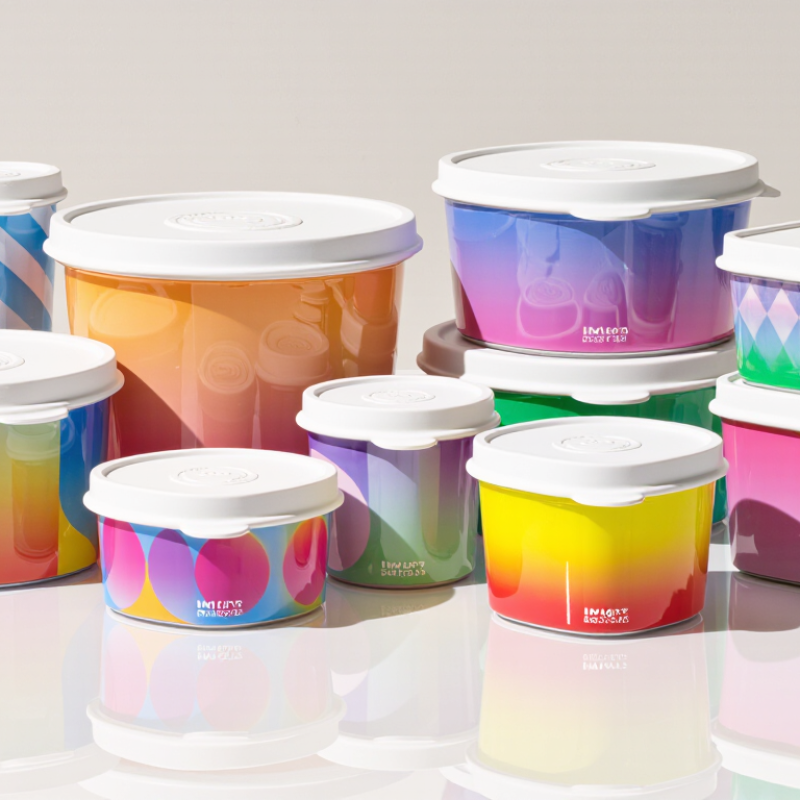
| 1 | Global IML Packaging Market | Estimated at approximately USD 1.1–1.4 billion across commonly reported market scopes | Most published forecasts indicate a mid-single-digit CAGR through 2030 | Automation, premium graphics, lower secondary labeling, and recyclable mono-material packaging | Use forecast ranges rather than a single figure because research firms define IML differently |
| 2 | China Demand Position | Strong demand from food, dairy, household products, and personal-care packaging converters | Expansion is expected to remain linked to domestic consumption and export-oriented packaging production | Large packaging-converting base, high injection-molding capacity, and e-commerce consumption | China-based suppliers can support high-volume production and competitive tooling costs |
| 3 | Primary Container Material | Polypropylene is widely used because of its food-contact suitability, stiffness, and heat resistance | Higher use of recyclable PP grades and downgauged structures is expected | Mono-material design, lightweighting, and compatibility with established recycling streams | Buyers should request resin grade, food-contact documentation, and recycled-content options |
| 4 | Food and Dairy Applications | One of the largest IML application groups, covering yogurt, spreads, ice cream, sauces, and ready meals | Continued growth supported by convenient single-serve and portion-controlled formats | Food safety, moisture resistance, full-wrap decoration, and high-speed filling lines | Confirm migration testing, odor control, sealing performance, and dimensional consistency |
| 5 | Household and Personal Care | Growing use in detergent, cleaning, cosmetic, and personal-care containers | Demand is expected to rise with premium surface decoration and refill-oriented packaging | Brand differentiation, chemical resistance, decoration durability, and shelf visibility | Evaluate ink adhesion, abrasion resistance, chemical compatibility, and cap-container fit |
| 6 | Typical Container Formats | Tubs, cups, pails, trays, jars, and other injection-molded rigid containers are common | More customized geometries, tamper-evident features, and stackable designs are expected | Convenience, logistics efficiency, portion sizing, and improved product presentation | Request drawings, tolerance charts, stack tests, drop tests, and production samples |
| 7 | Decoration and Print Quality | High-resolution flexographic, offset, and gravure printing are widely used for IML labels | Shorter runs, variable graphics, matte effects, metallic effects, and tactile finishes will gain attention | Premiumization, visual differentiation, and elimination of separate labeling operations | Check color-management capability, print registration, label placement, and artwork approval procedures |
| 8 | Sustainability Requirements | Lightweighting and recyclable PP structures are increasingly requested by international buyers | Design-for-recycling, reduced material use, and documented environmental data will become more important | Packaging regulations, retailer requirements, carbon reduction targets, and consumer expectations | Ask for material declarations, recyclability guidance, recycled-content records, and lifecycle data where available |
| 9 | Production and Quality Controls | Export-ready suppliers commonly emphasize automated molding, inline inspection, and batch traceability | Digital inspection, statistical process control, and stronger supplier documentation are expected | Lower defect rates, stable supply, food-safety compliance, and repeatable decoration quality | Verify ISO 9001, food-safety systems where applicable, inspection plans, and corrective-action procedures |
| 10 | International Buyer Selection Priorities | The most important factors are total cost, tooling support, minimum order quantity, lead time, compliance, and export service | Buyers will increasingly prioritize supply resilience, regional inventory, technical support, and verified sustainability claims | Global sourcing diversification, shorter launch cycles, regulatory scrutiny, and demand for customized packaging | Compare suppliers using the same RFQ, sample approval criteria, testing protocol, and landed-cost calculation |