
Top 10 Types of Marine Steel Pipes Buyers Should Know?

Marine Steel Pipes are critical in shipbuilding, offshore platforms, seawater systems, and port infrastructure. They carry fuel, ballast water, cooling fluids, steam, and sometimes fire-suppression media. Their failure can cause costly downtime and serious safety risks. Buyers should understand pipe types before comparing prices.

This guide introduces ten common types of marine steel pipes and explains where each one performs best. The selection may include seamless pipes, welded pipes, galvanized pipes, stainless steel pipes, and pipes designed for low-temperature service. Each option has different strengths. Wall thickness, diameter, pressure rating, corrosion resistance, and weldability all matter. A pipe that works well for freshwater circulation may fail quickly in seawater.

Look closely.

Experienced buyers also check manufacturing standards, inspection records, heat numbers, and material certificates. Classification requirements from organizations such as DNV, ABS, or Lloyd’s Register may apply to specific marine projects. However, certification alone does not guarantee a perfect purchase. Specifications must match the vessel design, operating temperature, fluid, and installation method. A supplier should provide traceable documents, dimensional data, test results, and practical technical support.

Real projects often reveal overlooked details. Salt spray can attack exposed surfaces. Tight engine-room spaces can make installation difficult. Poorly matched fittings may create leakage points. Even experienced teams sometimes focus too heavily on unit price. That mistake deserves reflection. The most economical pipe is not always the lowest-cost solution over its service life.

Understanding these ten pipe categories helps buyers ask sharper questions, reduce procurement risks, and choose materials with greater confidence.
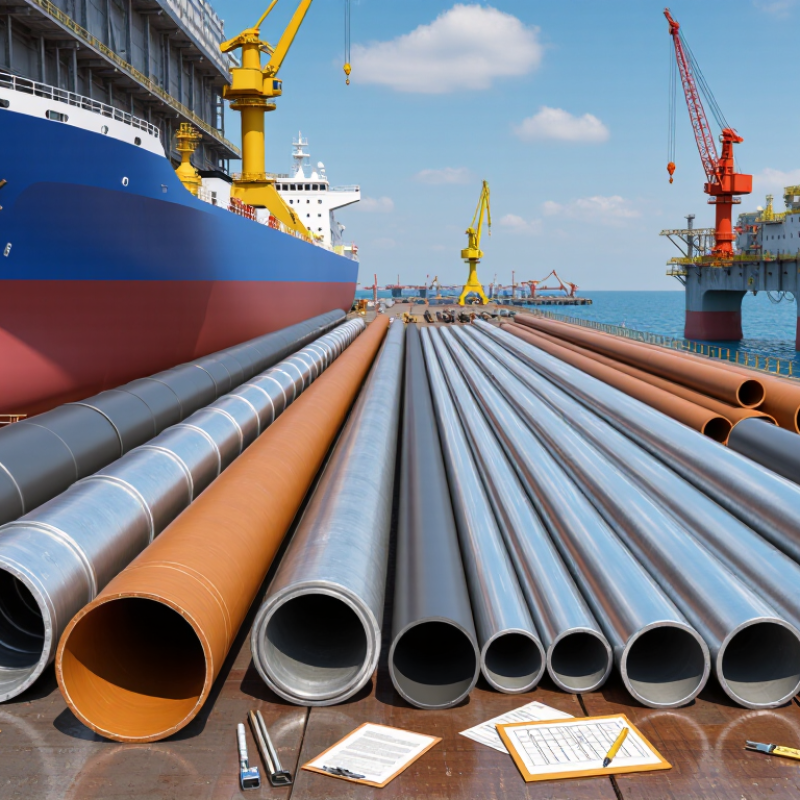
Top 10 Types of Marine Steel Pipes Buyers Should Know?

Marine Steel Pipe Fundamentals: Roles, Forms, and Classification

Marine steel pipes serve different roles, so classification should begin with service conditions. Hull structural pipes support frames and platforms, while piling pipes carry loads below water. Ballast pipes manage vessel stability. Seawater cooling pipes transfer heat but face aggressive corrosion. Fire-main pipes must deliver dependable flow during emergencies. Fuel pipes require controlled cleanliness and suitable material selection. Hydraulic pipes handle pressure in steering and lifting systems. Exhaust pipes tolerate heat, vibration, and condensation. Cargo pipes transfer regulated liquids. Deck-drainage pipes remove rainwater and wash water.

Their forms also matter. Seamless pipes offer consistent walls for demanding pressure applications. Electric-resistance-welded pipes suit many moderate-pressure services. Longitudinal submerged-arc-welded pipes provide large diameters with controlled weld quality. Spiral-welded pipes are useful for large flow paths, though their design needs careful review. Coatings, cathodic protection, wall thickness, and corrosion allowance further separate one pipe from another. A pipe may look strong but still fail when seawater, cyclic loads, and poor drainage work together.

In practice, buyers should check the service medium, design pressure, temperature, diameter, steel grade, weld procedure, and inspection records. Ultrasonic or radiographic testing can reveal hidden weld defects. Certificates support traceability, but paperwork alone cannot replace dimensional checks and visual inspection. I have seen classifications become too tidy; real projects often overlap. A cooling line may face vibration, corrosion, and pressure at the same time. That is where practical review matters.

Ten Essential Marine Steel Pipe Types Explained by Design and Function

Ten Essential Marine Steel Pipe Types Explained by Design and Function

Marine steel pipes are selected by pressure, corrosion exposure, temperature, and installation method. Seamless pressure pipes suit high-pressure hydraulic lines and critical services. Electric-resistance-welded pipes often serve freshwater, ballast, and general utility systems. Longitudinal submerged-arc welded pipes provide reliable strength for larger diameters. Spiral-welded pipes can reduce material waste in large-diameter seawater or dredging applications. Their weld quality still needs careful inspection.

Corrosion-resistant alloy pipes handle aggressive seawater and chemical environments. Internally lined pipes add protection where the base steel needs help. External coated pipes resist salt spray, but damaged coating can expose steel quickly. Boiler and superheater pipes withstand elevated temperatures in power systems. Precision hydraulic pipes support steering, lifting, and control equipment. Structural and piling pipes carry loads in offshore frames, docks, and marine foundations. Ten types, but no universal choice. Designers should check pressure ratings, corrosion allowance, impact toughness, weld procedures, and nondestructive testing requirements. Classification approval may also affect dimensions and inspection records. A thicker wall is not always safer; it can increase weight, welding difficulty, and fatigue stress. That detail is easy to overlook.

Top 10 Types of Marine Steel Pipes Buyers Should Know? - Ten Essential Marine Steel Pipe Types Explained by Design and Function

No. Marine Steel Pipe Type Design and Manufacturing Method Typical Marine Function Common Materials or Grades Representative Size Range Main Buying Considerations Typical Applicable Standards
1 Seamless Carbon Steel Pipe Manufactured from a solid billet without a longitudinal weld. It provides uniform integrity for pressure-service applications. High-pressure steam, fuel-oil, hydraulic, compressed-air, and piping systems requiring reliable pressure containment. Carbon steel such as ASTM A106 Grade B or equivalent marine-approved grades. Approximately DN15–DN600; wall thickness is selected according to pressure, temperature, corrosion allowance, and class rules. Pressure rating, heat-treatment condition, hydrostatic or nondestructive testing, dimensional tolerance, and certification. ASTM A106, ASTM A530, ISO 15649, and applicable marine classification requirements.
2 Electric Resistance Welded (ERW) Pipe Formed from steel strip or coil and welded along the longitudinal seam using electric resistance or high-frequency welding. General service, cooling water, ballast, fire-main, low-to-medium-pressure utility, and structural piping. Carbon steel, galvanized steel, and selected low-alloy grades; ASTM A53 grades are commonly specified for general service. Approximately DN15–DN600, with larger sizes available under specific production arrangements. Weld-seam quality, coating condition, ovality, end preparation, pressure testing, and suitability for cyclic marine loads. ASTM A53, ASTM A135, EN 10217, and project or classification-society requirements.
3 Longitudinal Submerged Arc Welded (LSAW) Pipe A wide steel plate is formed into a cylinder and welded along one longitudinal seam, usually by submerged arc welding. Large-diameter ballast, seawater intake, dredging, jacket, offshore, and high-capacity process piping. Carbon steel and low-alloy steel; grades are selected according to strength, toughness, and service temperature. Approximately DN400–DN1600 or larger, depending on plate width and forming equipment. Plate quality, weld procedure qualification, seam inspection, dimensional accuracy, toughness, and corrosion protection. API 5L, ISO 3183, EN 10219, and relevant offshore or marine project specifications.
4 Spiral Submerged Arc Welded (SSAW) Pipe Steel strip is helically formed and joined with a spiral submerged arc weld, allowing large diameters to be produced efficiently. Large-volume ballast, seawater, dredging, cooling-water, intake, discharge, and temporary marine construction lines. Weldable carbon steel and low-alloy steel, commonly supplied with external or internal protective coatings. Approximately DN400–DN3000, with the available range depending on strip width and design requirements. Spiral seam geometry, weld inspection, coating adhesion, buckling resistance, and suitability for pressure and external loads. API 5L, ISO 3183, AWWA C200, and project-specific marine specifications.
5 Stainless Steel Marine Pipe Seamless or welded pipe manufactured from corrosion-resistant stainless steel for aggressive, wet, or hygienically controlled environments. Seawater systems, potable water, galley services, chemical lines, exhaust components, and selected deck piping. 304L and 316L stainless steel; 316L is generally preferred over 304L for chloride-exposed service. Approximately DN15–DN600 for common shipboard piping systems. Pitting and crevice-corrosion resistance, molybdenum content, weld passivation, chloride level, and galvanic compatibility. ASTM A312, ASTM A358, EN 10217-7, and applicable seawater-service requirements.
6 Duplex Stainless Steel Pipe A ferritic-austenitic stainless steel with a two-phase microstructure, combining high strength with strong resistance to chloride corrosion and stress-corrosion cracking. Seawater cooling, ballast-water treatment, firewater, desalination, offshore process, and high-chloride piping. Duplex 2205 and super duplex grades such as 2507, subject to design temperature and chloride conditions. Approximately DN15–DN600; large diameters are available mainly as welded pipe. Phase balance, solution annealing, ferrite content, weld heat input, pitting resistance, and prevention of embrittlement. ASTM A789, ASTM A790, ASTM A928, and applicable marine classification rules.
7 Galvanized Steel Pipe Carbon steel pipe coated with zinc, usually by hot-dip galvanizing, to provide sacrificial corrosion protection. Freshwater, drainage, ventilation supports, deck utilities, handrails, and selected low-temperature service lines. Carbon steel with a zinc coating; the base pipe may be welded or seamless. Approximately DN15–DN300 for common utility and service applications. Zinc-coating thickness, cut-end protection, compatibility with potable water, temperature limits, and avoidance of unsuitable seawater exposure. ASTM A123, ASTM A53, ISO 1461, and project-specific coating requirements.
8 Boiler and Heat-Exchanger Tube Precision seamless or welded tube designed for heat transfer, elevated temperature, and controlled dimensional tolerances. Marine boilers, economizers, condensers, evaporators, feedwater heaters, and other heat-exchange equipment. Carbon steel, low-alloy steel, stainless steel, copper-nickel, and other heat-resistant alloys selected for the service. Common outside diameters are approximately 12.7–114.3 mm, with wall thickness based on pressure and heat-transfer design. Creep strength, thermal cycling, tube expansion, surface cleanliness, eddy-current testing, and leak-tightness. ASTM A192, ASTM A179, ASTM A213, EN 10305, and applicable boiler or pressure-equipment rules.
9 Copper-Nickel Marine Pipe Seamless or welded non-ferrous pipe made from copper-nickel alloy, valued for seawater corrosion resistance and biofouling resistance. Seawater cooling, condensers, firewater, ballast, marine sanitation, and seawater circulation systems. 90/10 copper-nickel and 70/30 copper-nickel alloys, selected according to velocity and seawater chemistry. Approximately DN15–DN600 for shipboard seawater piping. Flow velocity, erosion-corrosion, weldability, dezincification-free fittings, galvanic isolation, and commissioning cleanliness. ASTM B466, ASTM B467, ASTM B543, and applicable marine piping specifications.
10 Structural Steel Hollow Section Circular, square, or rectangular hollow sections manufactured by cold forming or hot finishing for load-bearing purposes rather than fluid transport. Masts, handrails, ladders, ship superstructures, offshore frames, walkways, and tubular supports. Structural carbon steel such as S235, S275, or S355, subject to required toughness and marine approval. Circular sections commonly range from approximately 20–1200 mm outside diameter; square and rectangular sizes vary widely. Yield strength, buckling resistance, fatigue performance, weldability, impact toughness, corrosion allowance, and coating system. EN 10210, EN 10219, ASTM A500, and applicable structural or offshore design codes.
Note: Size ranges and material selections are representative. Final pipe dimensions, pressure classes, testing requirements, coatings, and certification should be confirmed against the vessel design, service conditions, applicable regulations, and marine classification rules.

Materials, Manufacturing Methods, and Performance Requirements

Marine steel pipes serve ballast lines, seawater cooling, fuel systems, exhaust equipment, and offshore structures. Material selection controls their service life. Carbon steel remains economical for low-temperature utility lines. HSLA steel reduces weight under structural loads. Stainless steel and duplex grades resist chloride attack better, but they demand stricter welding control. Copper-nickel alloys perform well in seawater, although they are not steel options.

Manufacturing changes performance. Seamless pipes suit high-pressure service because they avoid longitudinal welds. ERW pipes offer consistent dimensions for general systems. Longitudinally submerged-arc welded pipes support larger diameters. Spiral-welded pipes can reduce cost, but weld quality needs careful inspection. Clad pipes combine a strong steel body with a corrosion-resistant internal layer. Galvanized pipes may help temporary or low-risk services, yet coatings can fail near cut edges.

The UNCTAD Review of Maritime Transport reports that more than 80% of global merchandise trade moves by sea. That scale makes pipe reliability a practical economic issue. The World Steel Association reported roughly 1.9 billion tonnes of crude steel production in 2024, but marine applications require far tighter quality control. Buyers should verify yield strength, impact toughness, wall tolerance, weld testing, and corrosion allowances. IACS requirements and project specifications often define these details. Saltwater is unforgiving. A thicker wall is not always safer. Poor drainage, trapped moisture, or an unqualified weld can defeat an expensive alloy. This is where specifications often need another review.

Top 10 Types of Marine Steel Pipes Buyers Should Know

Representative minimum specified yield strength values for widely used marine, offshore, and pipeline steel pipe materials. Actual requirements vary by pipe diameter, wall thickness, temperature, corrosion conditions, and governing standard.

Seamless and welded carbon steel grades are commonly selected for structural, utility, and fluid-service applications. Stainless, duplex, and super duplex grades provide improved resistance to seawater corrosion, while higher-strength API 5L and shipbuilding grades support demanding pressure and structural requirements.

Marine Applications for Each Steel Pipe Type on Ships and Offshore Structures

Marine steel pipes serve different duties, and their shape, grade, and coating affect onboard safety. Seamless pipes suit high-pressure hydraulic lines, boiler circuits, and compact fuel systems. ERW pipes work well in low-pressure ballast, bilge, and service-water lines. Longitudinally welded pipes support larger seawater, cooling, and fire-main systems. Spiral welded pipes are practical for wide-diameter intake and discharge lines, especially on offshore platforms. Check weld quality carefully.

Galvanized steel pipes resist atmospheric moisture in deck drainage, ventilation, and utility-water systems. Stainless steel pipes handle seawater, chemical washdown, and hygienic freshwater lines, although crevice corrosion remains possible. Duplex stainless pipes provide stronger resistance in seawater risers, ballast systems, and offshore process piping. Low-temperature carbon steel pipes are used for exposed lines in cold regions, where brittle fracture requires strict impact testing. Small details matter.

Clad pipes combine a strong carbon-steel outer layer with a corrosion-resistant inner surface. They can carry produced water, injection water, or mildly aggressive fluids on offshore structures. Line pipes transport oil, gas, or treated fluids between processing units and marine terminals. In practice, engineers match each type with pressure, temperature, fatigue, and corrosion data. Mill certificates, ultrasonic testing, weld procedure records, and classification approval should be reviewed before installation. I would not select by price alone. Field access, coating damage, and poorly supported joints often create problems that the original design missed.

How Buyers Select Marine Steel Pipes for Safety, Compliance, and Durability

Top 10 Types of Marine Steel Pipes Buyers Should Know

Marine pipe selection is a safety decision, not a simple price comparison. UNCTAD’s Review of Maritime Transport 2024 reports that over 80% of global merchandise trade by volume moves by sea. That scale makes reliable piping essential. Buyers commonly compare seamless, ERW, LSAW, SSAW, galvanized, stainless steel, duplex, clad, line, and corrosion-resistant alloy pipes. Each type suits different pressure, temperature, seawater, and fabrication conditions.

Safety starts with the service environment. Seamless pipes suit high-pressure systems, while ERW pipes can support cost-sensitive, lower-risk applications. Duplex and clad pipes resist chloride attack in seawater systems. Buyers should verify wall thickness, impact toughness, weld quality, hydrostatic testing, and traceability. Class requirements and IACS rules should guide inspection. SOLAS-related equipment also demands documented compliance.

The IMO 2023 GHG Strategy targets net-zero shipping emissions around 2050, increasing attention to fuel, exhaust, and alternative-energy piping. Material choices may need to withstand unfamiliar fuels. That part is still evolving.

Tips:

Request mill certificates, heat numbers, NDT records, and coating data. Check tolerances against the actual joint design. A low price can look rational; it often is not. My own checklist still needs revision when temperature, vibration, or seawater chemistry changes. Include spare lengths for onboard repairs, but avoid unnecessary inventory. Test samples under realistic pressure and corrosion conditions before approving large quantities.

Learn More

Connect with us today to learn more about our industrial automation solutions—and how to commission them for your application.