Why Choose a Three Phase RCBO for Global Procurement?
Global procurement teams increasingly choose a Three Phase Rcbo for commercial buildings, workshops, data centers, and industrial machinery. This device combines residual-current protection with overcurrent protection in one coordinated unit. It can help reduce panel space, simplify installation, and improve fault response across three-phase circuits.
John Drengenberg, former Consumer Safety Director at UL, has emphasized a practical principle: “Safety is not a feature added at the end; it must be designed into the system.” That principle matters when selecting a Three Phase Rcbo for international projects. Buyers must examine rated voltage, current capacity, pole configuration, tripping curve, residual-current type, breaking capacity, and terminal design. A device suitable for a 400-volt European panel may not fit a 415-volt industrial system without careful verification.
Small details matter.
A procurement manager may focus on unit price, yet compatibility often determines the real cost. Incorrect busbar spacing, unclear markings, or limited documentation can delay commissioning. Reliable suppliers should provide test reports, installation instructions, traceable certifications, and consistent batch quality. Regional standards also require professional review before purchase and installation.
The choice is not always simple. Some projects need selective coordination, stronger short-circuit performance, or Type B residual-current detection. Others may need a different protective arrangement entirely. That uncertainty deserves attention. A Three Phase Rcbo is valuable when its electrical characteristics match the system, not merely when its catalogue description looks impressive. Careful specification, independent verification, and local engineering experience create a safer procurement decision.
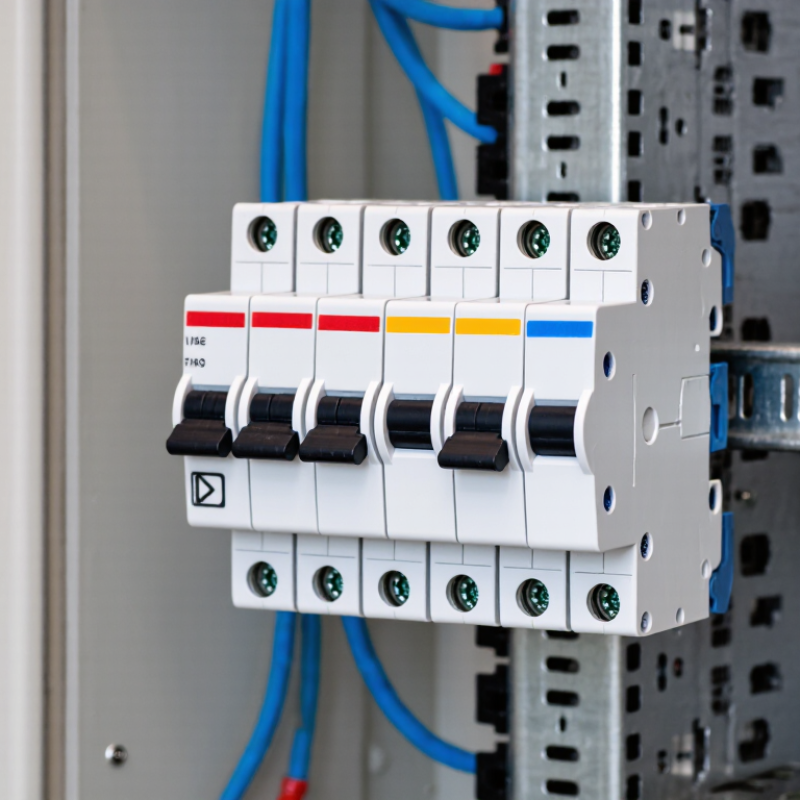
Three-Phase RCBO Fundamentals: IEC 61009-1 and 400–415 V Systems
When a procurement team evaluates a three-phase RCBO, IEC 61009-1 should be the starting reference. This standard covers residual current circuit-breakers with integral overcurrent protection for household and similar applications. It addresses electrical performance, temperature rise, insulation, operation, and verification tests. Check the marking. Look for rated voltage, current, residual trip rating, frequency, pole arrangement, and short-circuit capacity. A device marked 400 V may not suit every 400–415 V installation.
In many European-style networks, 400–415 V is measured between phases, while approximately 230 V appears between phase and neutral. A three-phase RCBO must match the actual circuit arrangement, including whether the neutral is switched and protected. Check the number of poles, trip curve, energy coordination, and prospective fault current. Type A residual-current detection is often considered where electronic loads create pulsating DC leakage, but the final choice depends on the equipment. Frequency also deserves attention; 50 Hz is common, not universal. Not always obvious.
Practical review should continue beyond the datasheet. Confirm terminal capacity, conductor size, tightening torque, enclosure temperature, and access to the test button. Ask for conformity evidence and test reports linked to the exact configuration, not a similar model. That distinction is easy to miss.
A catalogue can look complete and still conceal a neutral mismatch or inadequate breaking capacity. Local code checks, installation records, and routine testing strengthen procurement decisions. During commissioning, one overlooked connection can expose an otherwise careful specification.
Comparing 6 kA and 10 kA Breaking Capacities for Fault-Risk Control
Why Choose a Three Phase RCBO for Global Procurement?
A three-phase RCBO combines overcurrent and residual-current protection in one device. Its breaking capacity matters when a fault occurs between phases or phase and earth. A 6 kA RCBO can interrupt fault currents up to 6,000 amperes under specified test conditions. A 10 kA unit can interrupt up to 10,000 amperes. That difference becomes important near transformers, generators, and dense industrial distribution boards.
IEC 60898-1 requires circuit breakers to withstand defined short-circuit tests, while IEC 60947-2 covers higher-performance industrial applications. The correct choice depends on the prospective fault current, not only the purchasing region. The International Energy Agency’s Electricity 2024 report expects global electricity demand to grow by about 4% annually through 2026. More load can mean stronger networks and higher fault levels. A 10 kA rating often provides useful engineering margin, especially where supply conditions vary between countries.
But higher capacity is not a magic shield. A 6 kA device may be fully suitable when measured fault current remains below its rating. Engineers should verify cable impedance, transformer capacity, backup protection, and local installation rules. Field experience also shows a common weakness: procurement teams sometimes compare only the kA figure. They should check trip curves, residual-current type, pole configuration, temperature derating, and coordination. The imperfect part is prediction. Network data can change after expansion, so conservative selection may prevent an expensive redesign.
Why Choose a Three Phase RCBO for Global Procurement?
Comparing 6 kA and 10 kA breaking capacities for fault-risk control
The chart compares rated breaking capacity with representative prospective fault-current values of 3, 5, 6, 8 and 10 kA. Headroom is calculated as rated breaking capacity minus prospective fault current. A 6 kA RCBO provides adequate capacity when the prospective fault current does not exceed 6 kA, while a 10 kA RCBO provides additional selection margin for installations with higher or less certain fault levels. Final selection should be based on the calculated or measured prospective fault current and the applicable installation standard.
Selecting Type A, AC, or B RCBOs for 50/60 Hz Global Applications
Why Choose a Three Phase RCBO for Global Procurement?
Selecting Type A, AC, or B RCBOs for 50/60 Hz Global Applications
Three-phase RCBOs combine overcurrent and residual-current protection in one device. They also simplify panel layouts and reduce wiring points. For global projects, frequency alone is not enough. The connected load matters more.
Type AC detects sinusoidal alternating residual current. Type A also detects pulsating direct current from rectifiers, chargers, and switching power supplies. Type B detects smooth DC and mixed-frequency leakage, making it suitable for inverters, variable-speed drives, and many electric vehicle charging systems. The IEA reported over 14 million electric cars sold worldwide in 2023. That growth increases the need to assess DC leakage carefully.
Type B is not automatically the best choice. It can increase cost and may complicate procurement across different markets. IRENA reported 473 GW of renewable capacity additions in 2023, much of it using power electronics. This trend strengthens the case for Type B in selected applications, not every circuit. Verify equipment manuals, leakage-current waveforms, neutral arrangements, and local installation rules. Check compliance with applicable IEC 61009-1 and IEC 62423 requirements.
A practical warning: a tidy specification can still be wrong. Some teams choose Type AC because the supply is 50/60 Hz. That assumption ignores modern electronic loads. Others specify Type B everywhere without reviewing measured leakage. Field measurements remain valuable. So does technical humility.
Procurement Checklist: 4-Pole Design, Ratings, and Regional Compliance
Why Choose a Three Phase RCBO for Global Procurement?
A three phase RCBO combines overcurrent protection and residual current protection in one compact device. For international projects, the 4-pole design deserves close attention. It switches all three phases and the neutral, helping isolate a circuit during maintenance or a fault. This arrangement can improve safety where neutral continuity and local wiring practices vary. However, pole configuration must match the distribution system. A four-pole device is not automatically suitable for every installation.
Check the rated voltage, current, frequency, short-circuit capacity, residual operating current, and trip characteristics. Confirm whether Type A, Type AC, or another RCD classification suits the connected loads. Electronic equipment may create pulsating or mixed leakage currents. Regional compliance also matters. Review applicable IEC, EN, UL, or national requirements, along with temperature, enclosure, terminal, and marking rules. Certification should cover the exact product configuration, not merely a similar model. Small details often delay approval.
Tips: Ask suppliers for test reports, wiring diagrams, installation instructions, and sample labels. Verify whether neutral switching is required by the destination authority. Compare the declared breaking capacity with the prospective fault current. Check terminal size using the actual cable, not a catalogue assumption. I have seen projects pass technical review but fail field installation because the neutral terminal was overlooked. That mistake is avoidable, though procurement teams sometimes focus too heavily on price. Keep a region-by-region checklist, and record every exception before ordering.